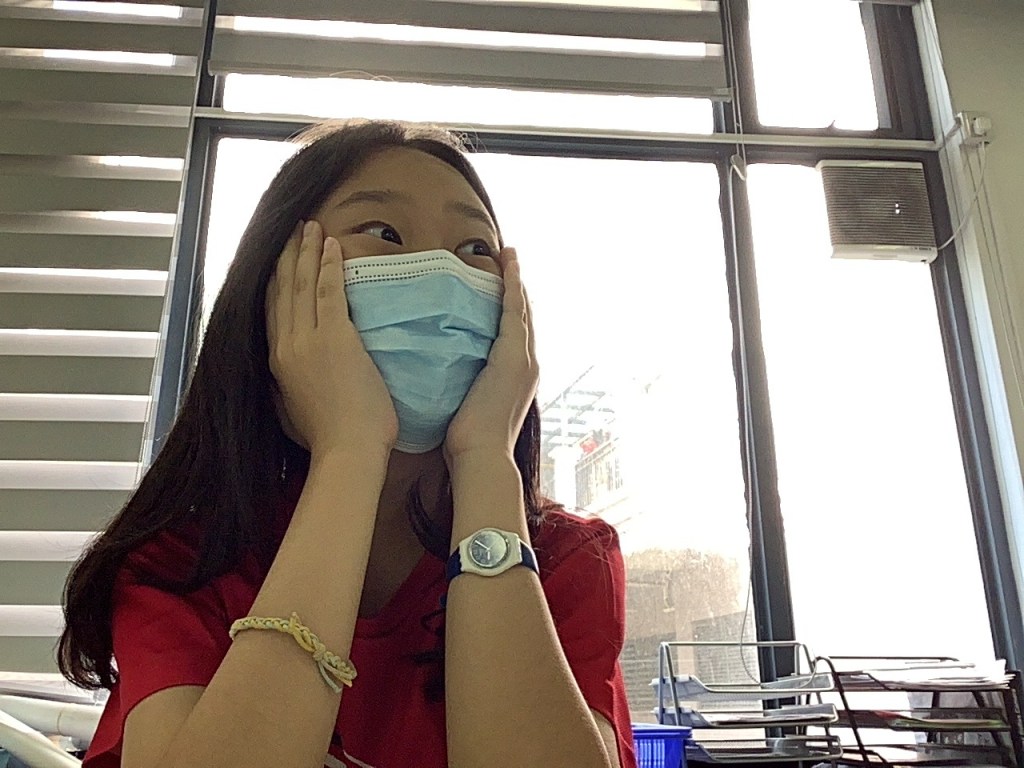
Eunseo Oh is a rising senior (class of 2026) who attends a Canadian public high school. After she was born, her family moved to China, and she attended a Chinese public school for kindergarten and elementary school. She uses Korean at home and visits Korea every summer break, but she is more comfortable using Chinese, and most people know her as a Chinese speaker. From Grade 6, she transferred to Shekou International School with an IB curriculum and located in Shenzhen city. After grade 9, she moved to Canada and attended a Canadian public high school located in Toronto.
Would you please introduce yourself and tell me where you currently live?
Eunseo: Hello, my name is Eunseo Oh, and my English name is Stella. I’ve been Claire’s friend since grade 6 in China. I’m living in Toronto, Canada. I’m attending a Canadian public high school, and I’m in grade 12, class of 2026.
What kind of countries have you lived in before?
Eunseo: I lived in China for most of my life. Since I was a baby, my family has moved to China, and I have attended a Chinese public kindergarten and elementary school, so I was surrounded by all Chinese people, and I was most comfortable with Chinese culture. Every summer break, I visited Korea and I used Korean at my home, but at that time, I was most comfortable with Chinese as I used it most in my daily life. After that, from grade 6 to grade 9, I attended Shekou International School with an IB curriculum, located in Shenzhen city.
I think you have diverse experience in different educational systems based on different countries. Can you share more about the different curricula that you have experienced till now?
Eunseo: I think when I was in Chinese public school, they had a lot of rules that I had to follow, it was kind of strict (laugh). Also, compared with an international school, there are a large number of people. Each class has an average of 30 people, and each grade has 10 to 12 classes.
However, when I transferred to Shekou International School, we only had 3 different classes and about 20 people for each class. This environment was able to create more connections with teachers, students, and get more attention from teachers, which was beneficial for getting extra help from teachers. Furthermore, because there are few people, every student has many opportunities for leadership, competition, or sports. As Shekou International School was an IB curriculum school, as I’m getting older, I realized that there are a lot of things that I have to prepare, and there is a lot of studying.
So, I moved to Canada, and the public school was of combination of a Chinese public school and an international school. The atmosphere of the school is free, but it also has a large number of students, which is similar to a Chinese public school. The school curriculum and class method are the same of an international school. Also, as a public school, the focus was different; if international schools felt like they provided one-on-one intensive care, here, there aren’t many opportunities, as one counselor is responsible for an average of 400 students.
As you have experienced different education in different countries, I believe there will be some challenges in different cultures. Would you please share some challenges and how you overcame them?
Eunseo: The first challenge was in elementary school. My nationality was Korean, but I grew up in China. I was more familiar with Chinese culture, which led to identity confusion. I felt like I didn’t belong anywhere. Then I moved to an International school where it requires English skills but I was not that fluent in the beginning compared with other students who use English daily. So I had very low confidence, and belonged to Chinese friends, about as humans are animals of adaptation (laugh), I was getting closer with Korean friends and other students from outside of Asia.
After that, in Canada, as it’s a public school, I was almost the only international student, so it was hard to find common ground with other students, which made it hard to make friends. The path of college was different as I’m thinking of colleges outside of Canada, the teachers are not familiar with my situation, so I have to research my own, and hard time to get advice. But I made new friends and based on different experiences that I had in China, I’m surviving now (laugh).
It seems like you’ve had a lot of experience as an international student. Are there any takeaways that you’ve gained from these experiences?
Eunseo: I would say adaptability, self-reliance, and diversity were the main takeaways. Going through various educational systems allows me to learn about perspectives I wasn’t aware of, helps me adapt more quickly based on the experience of friends I met at various schools, and gives me the opportunity to reflect on myself. I feel like I’m maturing through this ongoing journey of discovering my identity. It’s very fun that life is like a roller coaster, with its ups and downs (laugh).
Eunseo’s journey illustrates the complexity and resilience of growing up across borders, where identity is constantly shaped by language, culture, and education. From navigating the strict structure of Chinese public schools to embracing the inquiry-based learning of the IB curriculum and the openness of Canadian education, she has gained a rare adaptability and independence. Her experiences highlight that being an international student is not only about adjusting to new systems, but also about building confidence, finding belonging, and learning to stand on one’s own. Eunseo’s reflections remind us that global citizenship is less about where you live and more about how you grow through differences: turning challenges into strength, and uncertainty into maturity. As she prepares for her future, she carries with her the adaptability, perspective, and self-reliance of someone ready to thrive in an interconnected world.
 Humans of Korea
Leave a comment