In today’s increasingly interconnected world, many students are growing up with influences from multiple cultures and educational systems. Sungeun Kim is one such student. Now a senior at Branksome Hall Asia, Sungeun is known for her strong sense of purpose and global outlook. With a clear goal of becoming a doctor, she is preparing to study medicine in the UK. Her journey reflects how a multicultural upbringing and international education can foster adaptability, empathy, and a sense of belonging across borders.
Could you please introduce yourself? What are your future plans after graduation?
Sungeun: My name is Sungeun Kim, and I am a senior at Branksome Hall Asia. I have dreamt of being a doctor passionately since Grade 8, so after graduation, I can picture myself finishing 6 years of studying at a medical school and then working at hospitals as a doctor, hopefully in the ER or the Trauma Center.
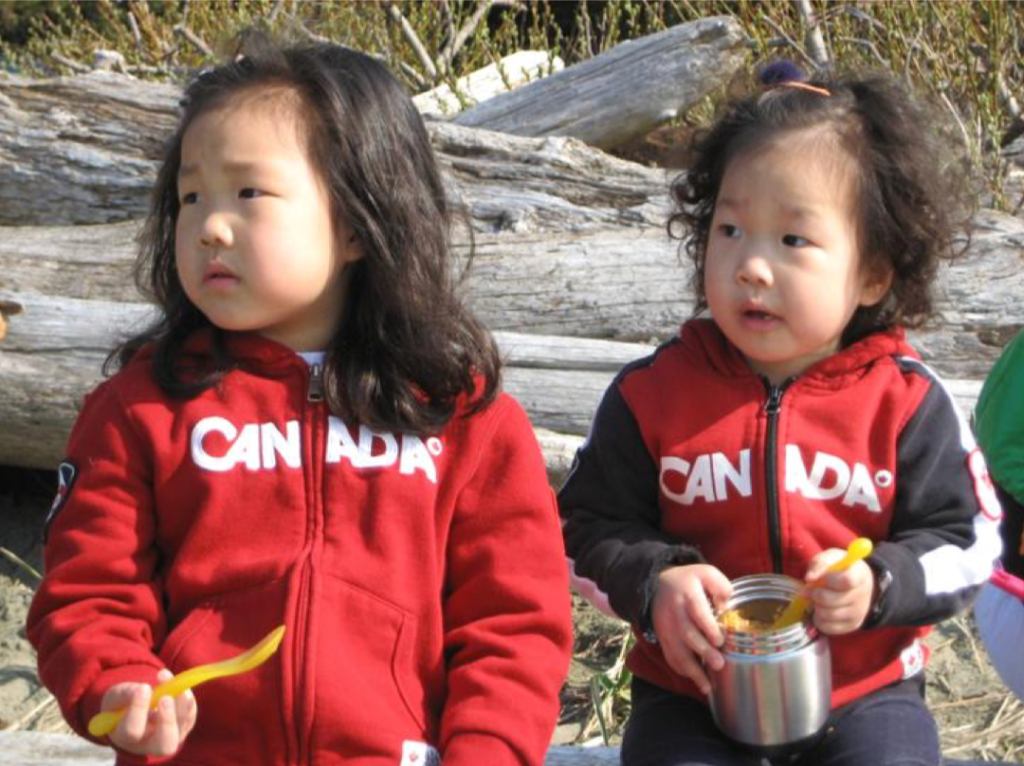
This is a photo of Sungeun and her sister, when they lived in Canada.
You grew up with a multicultural background—your mother is of mixed heritage, and your sister is currently studying in the UK. Have you had any memorable or culturally eye-opening experiences while navigating different cultures?
Sungeun: My life was full of new cultures. Apart from my mom and sister, my aunt and uncle are Canadians, and my cousins are Chinese. Therefore, whenever our family would plan family trips, they were all memorable and culturally eye-opening. I encountered not only Asian culture, but also other ones while talking with them or even while eating food. One thing that I learnt as a person who grew up with a multicultural background was that every culture is amazing and beautiful, and there is no such culture that should be treated unequally.
This is funny, but also one of my absolute most memorable experiences. Most of my family is from Korea, Japan, and China, which are all Asian countries. However, only my aunt and uncle are from Canada, and they have a very different lifestyle compared to us. My aunt was still raised in Korea, but my uncle is half Canadian and half Hong Kongese. When I first met him, I was worried that he might feel pressured in getting used to our culture and how our family lives, and when he first arrived, he looked confused, especially when sharing food. Over time, he was used to Asian culture and he was just like one of us. From this experience, I learned that adapting to one’s culture depends on your mindset, and there is no such excuse that could stop one from assimilating into a new culture.

This is a photo of the building in the UK, taken by Sungeun.
We heard you recently visited your sister in the UK. Were there any noticeable cultural differences between Korea and the UK that stood out to you during your time there?
Sungeun: My sister is currently studying at Edinburgh, UK, and since I am planning to apply to UK universities, our family thought it would be nice to visit the UK before applying. There were two noticeable cultural differences while I was there for almost a month. I have always heard that people living outside of Asia, and especially Korea, don’t tend to care about others, in a good way, such as minding one’s body shape, skin tone, or even their personality. Differently, in Korea, it is all about being pretty and skinny, which decides if someone is attractive or not. I thought that the UK culture, and probably a lot of others too, prioritized myself more than others. Also, this is kind of a bad experience that I encountered, but maybe because people prioritize themselves, they weren’t really thinking about basic etiquette. A lot of people blew cigarette smoke in front of my face, even though they knew that I was going to walk in front of them. This is not imaginable in Korea, where cigarettes are treated kind of negatively and where drugs are illegal.
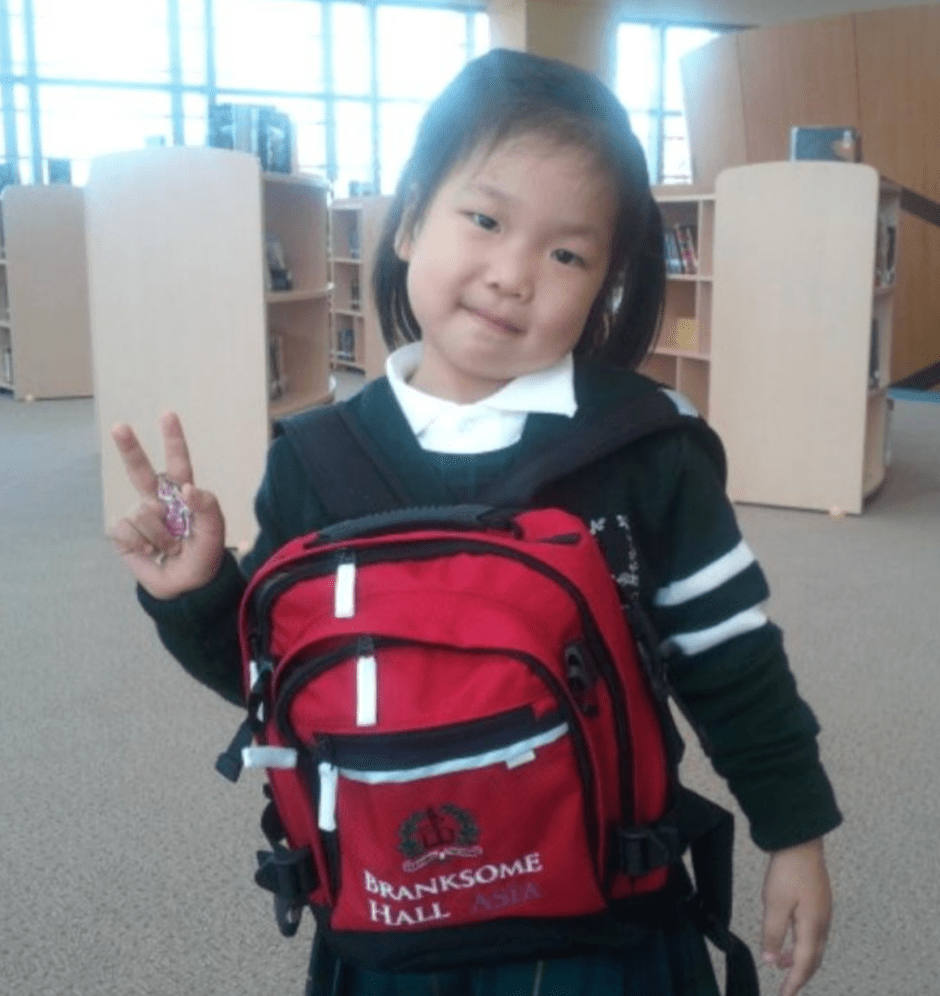
This is a photo of young Sungeun in Branksome Hall Asia Library
Although you were raised in Korea, you attended international schools from kindergarten onward and followed a global curriculum. What are some advantages and challenges of having been educated in an international system, particularly the IB?
Sungeun: As I graduate this year, I am completing fourteen years of being a student at an international school. The biggest takeaway from following a global curriculum, in general and not specific to the IB, is that there is no boundary between me and any other foreign country. I have encountered many foreigners in my life, including teachers and friends, and my very first friend was from Belgium. The open mindset helped me to adapt quickly to unacquainted situations, such as never feeling left out even though there aren’t any Koreans. Another advantage would be that English feels like my second mother tongue. Unlike people who learn their second language after being fluent in their mother tongue, I learnt English along with Korean, and basically I have developed them to the same level. English is now one of the most comfortable languages I have a good command of, and considering the fact that I will be working abroad in the future, this would be the biggest advantage I have gained from being educated in an international system.
Particularly for the IB program, it focuses on the independence of individuals through critical thinking and a holistic approach to education. Not only critical thinking skills, but IB has shaped me as an individual who can seek help when needed, but also know how to find solutions on my ability. There were, of course, challenges in between these learning situations, such as dealing with stress; however, all of the challenges were one learning opportunity that could not be wasted.
Sungeun’s reflections reveal the depth and complexity of growing up between cultures, not just in daily habits, but in values, perspectives, and relationships. Whether learning resilience through cultural adaptation, or embracing the independence and inquiry-driven mindset of an international curriculum, she has developed the tools to navigate a global society with confidence and purpose. Her story reminds us that cultural openness is not only about travel or language, it’s about being willing to learn from differences, to connect across unfamiliar lines, and to carry those lessons into the future. As Sungeun steps into the next chapter of her journey toward becoming a doctor, she embodies the mindset of a new generation ready to heal and lead in a borderless world.
 Humans of Korea