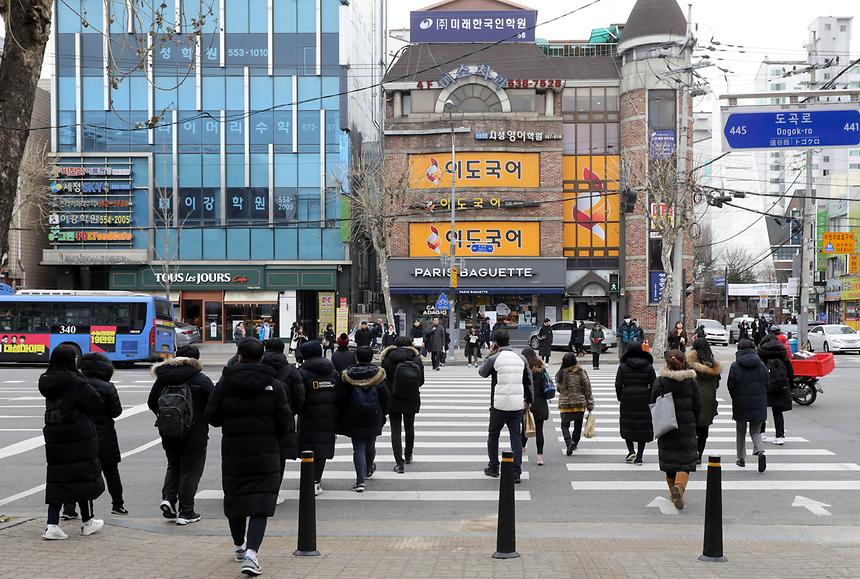
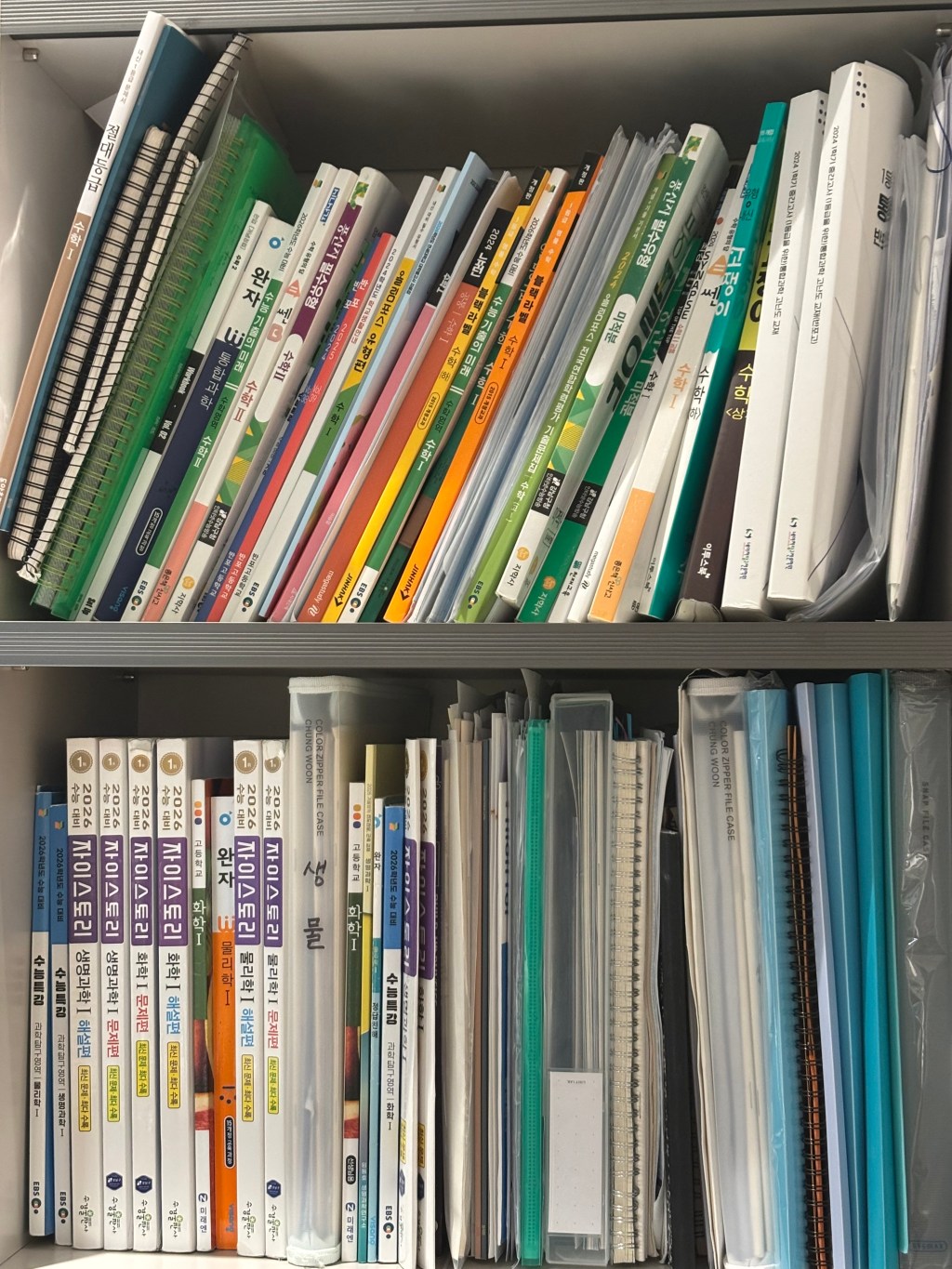
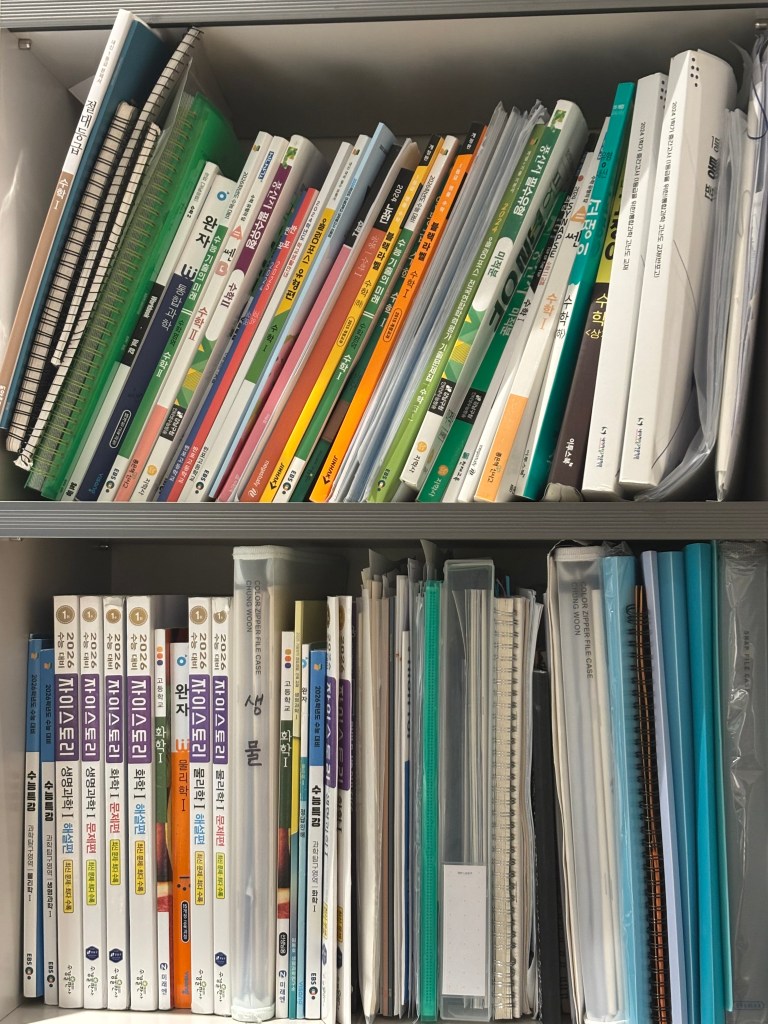
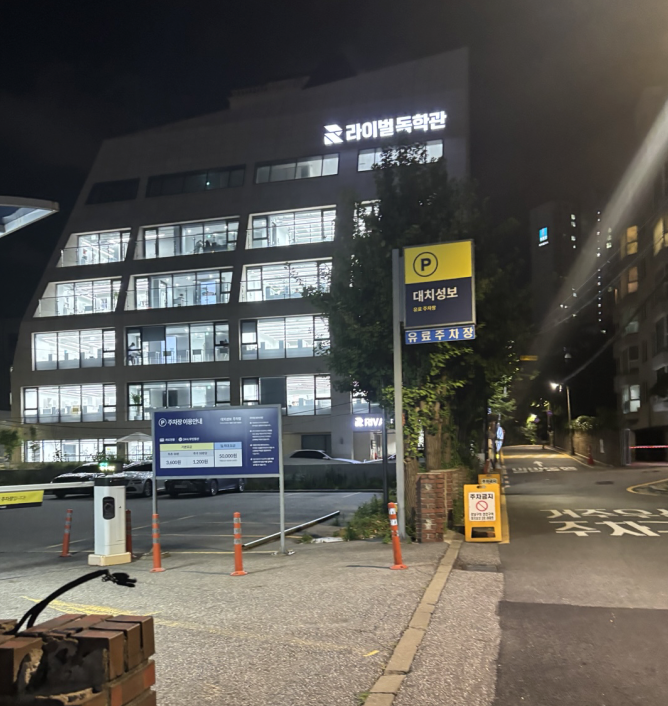
Juyeon is a Grade 11 student living in Daechi-dong, an area widely known for its concentration of private academies. She has lived her entire life in Korea and has attended only Korean public schools, while spending most of her evenings and weekends at hagwons preparing for major exams. As a humanities track student, she feels strong pressure to perform well academically, since university name plays a major role in future opportunities. Her daily routine reflects the reality of many Korean students growing up in an exam focused education system shaped by competition, financial gaps, and social expectations. Through her experience, Juyeon offers insight into student life inside one of Korea’s most academically intense environments.
What does a typical weekday look like for you as a student in Daechi-dong?
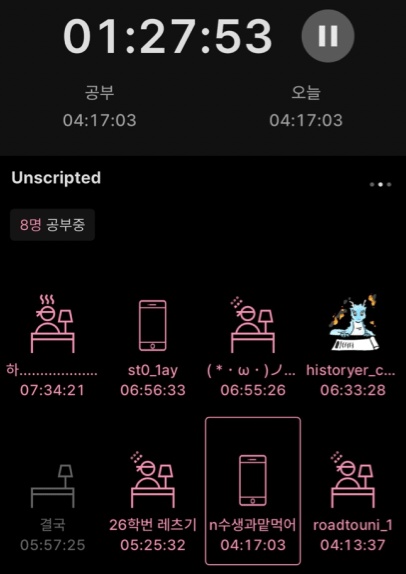
Juyeon: On weekdays, I wake up early for school and spend the whole day in classes. As soon as school ends, I head straight to academies. I attend different hagwons for Korean, English, and social studies, and I usually get home close to midnight. Even after that, I feel pressure to review what I studied or plan the next day. There is barely any time to rest, and studying shapes almost everything in my daily life.
How does studying in Daechi-dong affect the way you see school and learning?
Juyeon: Being in Daechi-dong makes learning feel competitive all the time. You are surrounded by students who study longer hours or attend more academies, so it is hard not to compare yourself. Sometimes learning feels less about interest and more about surviving the system. I still enjoy certain subjects, but the focus on scores and rankings makes it difficult to fully enjoy learning.
What do you think about the exam and academy centered study culture in Korea?
Juyeon: I think this culture pushes students to work extremely hard, but it also creates constant pressure. Studying becomes something you have to do rather than something you want to do. While the system can produce strong academic results, it does not leave much space for students to rest, explore interests, or think about who they are outside of grades. I believe education should support growth in more balanced ways, not just prepare students for exams.
Juyeon’s story reflects the reality of student life in Daechi-dong, where long study hours, competition, and expectations shape everyday routines. Her experience shows how Korean students balance public school, private academies, and social pressure in an environment where academic performance carries heavy weight. At the same time, her reflections reveal the emotional strain of growing up in an exam centered system. Through her perspective, we gain a clearer understanding of how education and culture shape student life in Korea, and how young people continue to search for direction while studying under constant pressure.
In today’s increasingly interconnected world, many students grow up navigating multiple cultures, languages, and educational systems. Siyoon Kim is one such student. Now a Grade 12 student at Branksome Hall Asia, she has spent her entire academic life in international schools, developing a global outlook shaped by diverse experiences both inside and outside the classroom. With a clear ambition to pursue pharmacy in university, she is preparing to enter a field that blends scientific inquiry with real-world impact. Her journey shows how international education and cross-cultural exposure can build adaptability, independence, and a deeper understanding of the world. As Siyoon looks ahead to her future studies and career, she represents a generation of students ready to learn, connect, and contribute across borders.
Could you please introduce yourself? What are your future plans after graduation?
Siyoon: My name is Siyoon Kim, and I am currently a Grade 12 student at Branksome Hall Asia. I hope to major in pharmacy at university because I have always been interested in the scientific and practical aspects of medicine. After completing my undergraduate studies, my plan is to continue on to graduate school and eventually take the national pharmacist licensure exam. My long-term goal is to become a licensed pharmacist and contribute to improving people’s health through safe and effective medication management.
What are some advantages and challenges of having been educated in an international system, particularly the IB?
Siyoon: One major advantage of the international and IB education system is the global perspective it offers. I was exposed to diverse cultures, ideas, and ways of thinking from a young age, which helped me become more open-minded and comfortable communicating in English. The IB curriculum also emphasizes critical thinking, research skills, and independent learning, which I believe will help me adapt well to university-level academics. However, there are also challenges. Assessment in the IB often depends heavily on teacher interpretation and subjective grading, which sometimes makes it difficult to understand exactly what is expected. Additionally, IB classes and exams tend to be long and intensive, requiring strong time management and endurance. While challenging, these experiences ultimately pushed me to become more disciplined and resilient.
Since your mother works as a flight attendant, I heard you’ve also traveled to many countries while accompanying her. Is there any experience from those trips, something surprising, eye-opening, or culturally different, that left a strong impression on you or made you realize how their lifestyle differs from ours?
Siyoon: Traveling with my mother gave me many meaningful experiences. One memorable place was Brisbane, in Queensland, Australia, where my aunt lives. It’s a rural area, and I was surprised by how beautiful and untouched the natural environment was. Seeing such open landscapes and wildlife made me realize how differently people live in countries with vast natural spaces compared to Korea. Another impression came from Barcelona, a city known for its unique architecture. Walking through the city, I was amazed by the artistic buildings and cultural atmosphere. However, I also noticed lifestyle differences– especially in food. Many meals were centered around hamburgers, pizza, fish and chips, and other Western dishes, and I found some seafood pastas with unfamiliar ingredients quite surprising. Even the structures of residential buildings felt completely different from what I was used to in Korea. These experiences helped me understand how lifestyle, environment, and culture shape daily living in different parts of the world.
Siyoon’s reflections reveal how international education and global travel can shape a student’s identity far beyond academics. Through the IB curriculum, she learned to think critically, work independently, and navigate demanding assessments with resilience. Through her travels, she encountered different lifestyles, landscapes, and cultures that broadened her understanding of how people live around the world. Together, these experiences helped her develop openness, adaptability, and the confidence to pursue her goals with clarity. Her story demonstrates that growing up between systems and cultures is not merely about exposure—it is about learning to see differences as opportunities for insight and connection. As she moves forward toward her future studies in pharmacy, she carries with her a worldview shaped by curiosity and a readiness to contribute meaningfully in an increasingly global society.
Daeun is a senior in Korea who recently took the 2026 CSAT (수능). She has lived her whole life in Korea and attended only Korean public schools. As a 문과 (humanities) student, her university choice is extremely important, shaping both her academic path and future opportunities. Her experience reflects the pressures of Korean public school life, where success is often measured by test scores and admission to top universities. Daeun’s story gives insight into student life in Korea, the role of societal expectations in shaping educational paths, and how young people make decisions about their futures in a highly competitive environment.
Can you describe how you felt while preparing for the 2026 CSAT and on the day of the exam?
Daeun: Preparing for the CSAT was exhausting but also intense in a way that taught me a lot about discipline and time management. I had to balance school classes, private academy sessions, and self-study, which sometimes felt overwhelming. On the day of the exam, I felt a mix of nervousness, anticipation, and relief because all the preparation led up to that moment. Even after finishing, there was still a lingering pressure to achieve a high score, since it plays such a big role in university admissions and in how society views success.
What were some of the biggest challenges you faced as a humanities student in Korea’s education system?
Daeun: One of the hardest things was feeling like the university name defined my entire future. For humanities students, especially, there is so much emphasis on entering a top school, and it often feels like our worth is measured by that. I also noticed how money can affect opportunities. Some students can afford extra academies or tutoring, which makes competition even more stressful. In addition, keeping up with both schoolwork and preparing for the CSAT while managing stress and sleep felt like a constant balancing act.
Have you thought about retaking the exam or exploring other options to improve your chances for university?
Daeun: Yes, it’s something I’ve seriously considered. A lot of students who want a more prestigious university think about retaking the CSAT. For me, I have to weigh the stress, time, and cost against the potential benefits. Being a humanities student, where top university names really matter, makes this decision even more difficult. I also had to think about whether I want to follow society’s expectations or find a path that feels right for me personally.
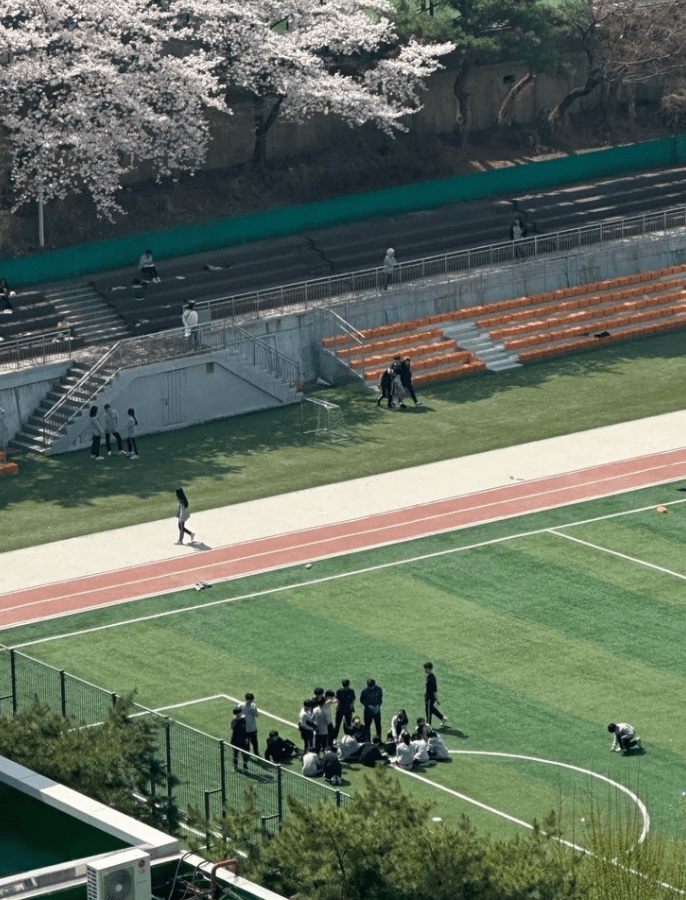
This is our school in spring!
How do societal and cultural pressures in Korea affect students’ experiences and choices?
Daeun: It’s hard not to feel the pressure. In Korea, there is a strong cultural focus on academic achievement, and many people equate success with getting into a top university. This can make school life stressful because grades and exam scores are often prioritized over learning, creativity, or personal interests. At the same time, I’ve seen how this pressure motivates some students to work incredibly hard, but it can also lead to burnout or self-doubt. It made me realize how different education systems can shape the way students experience growing up.
Looking back, what lessons or perspectives have you gained from preparing for the CSAT and experiencing student life in Korea?
Daeun: I’ve realized that education is about more than just exams. Learning to manage stress, seek support from friends and family, and reflect on what matters to me personally has been just as important as studying. I’ve also understood that there are many ways to measure success and that following only what society expects doesn’t always lead to fulfillment. Even in a competitive system, moments like discussing ideas with classmates or sharing tips with friends reminded me that student life also includes learning from each other and building connections, not just focusing on the test.
Daeun’s experience highlights the real experiences of student life in Korea, where education, culture, and societal expectations are tightly linked. For humanities students, the university name carries significant weight, shaping both personal and academic decisions. Her story reflects the pressures of preparing for the CSAT, balancing schoolwork, and making choices under a highly competitive system. At the same time, it shows that growth comes from learning to manage stress, reflect on personal goals, and value connections with peers. Daeun’s perspective offers a glimpse into how culture and education shape students’ lives and the ways young people adapt and make choices in modern Korean society.
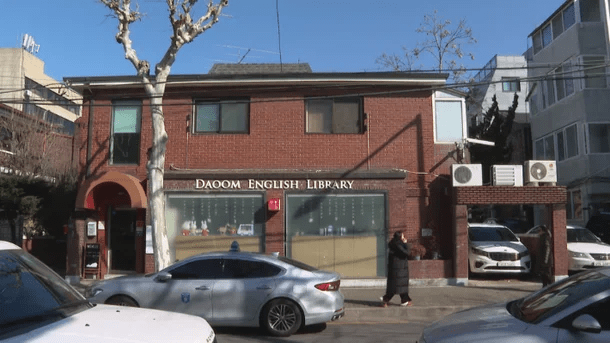
Ms. Lim is the librarian at Daoom English Library, a community space designed to serve local elementary, middle, and high school students. The library provides a welcoming environment much like a neighborhood study room, offering a wide collection of English books, multimedia resources, and diverse programs for students seeking to strengthen their English skills or pursue their dreams through the language. Established by Daoom Church as a way to serve the community, the library has grown into a place of shared learning and joy for both students and volunteers alike. Ms. Lim plays a central role in organizing these programs, including the Newspaper in Education (NIE) sessions where volunteers from Lectio, including Kaiden and me, guide young students through interactive English activities. Through her dedication and care, Ms. Lim helps bridge language gaps and nurtures a space where curiosity and community come together.
Daoom English Library welcomes students from different backgrounds and learning levels. How do you see cultural diversity influencing the way children learn and interact here?
Ms. Lim: I think the diversity here helps students learn not only English but also about each other. Some children are more confident, while others are still shy with the language, but they naturally help one another. When they share ideas or stories from school or home, it creates a very open and kind atmosphere. It is not just studying; it is learning to understand different people. In Korean public schools, students usually focus more on grammar or exams, so they do not have much chance to speak freely. Because the world is becoming more globalized, I think spaces like Daoom are important for helping students build confidence in real communication.
What do you think makes the NIE program helpful or special for the kids who come here?
Ms. Lim: The NIE program connects English with real topics from newspapers. Instead of just memorizing words, the students think and talk about what is happening around them. It makes English feel more alive and useful. I can see their confidence growing as they express their thoughts in simple English sentences. Many Korean students learn English mainly through textbooks, so they often feel nervous using it in daily life. Here, they realize that English can be a tool for sharing their opinions, which fits the world they are growing into.
How is ur experience with the ovlunteers from different schools? How did they help with the library?
Ms. Lim: The volunteers bring a lot of energy and creativity. They make the lessons fun and help students feel more comfortable speaking. I also think the younger kids look up to them because they see that studying English can be enjoyable, not stressful. The volunteers also help organize activities and prepare materials, which really supports our small team here. Many volunteers also share stories from their own schools, showing students that English is used in many different ways. This kind of exposure helps children see English not as a test subject, but as a bridge to the wider world.
This is a photo of our volunteers!
Daoom feels like more than just a library; it’s like a community space. What do you think makes this place different for students?
Ms. Lim: Daoom is a warm and welcoming space. We want it to feel like a second home where students can relax, read, and learn freely. There is no pressure here, only encouragement. I think that is what makes it special. Many of our students stay after class to talk or read more, which shows that they feel safe and cared for here. In most schools, there is little time to explore English naturally, but here they can take their time. Because English is becoming more essential in global society, I hope this space helps students gain confidence step by step.
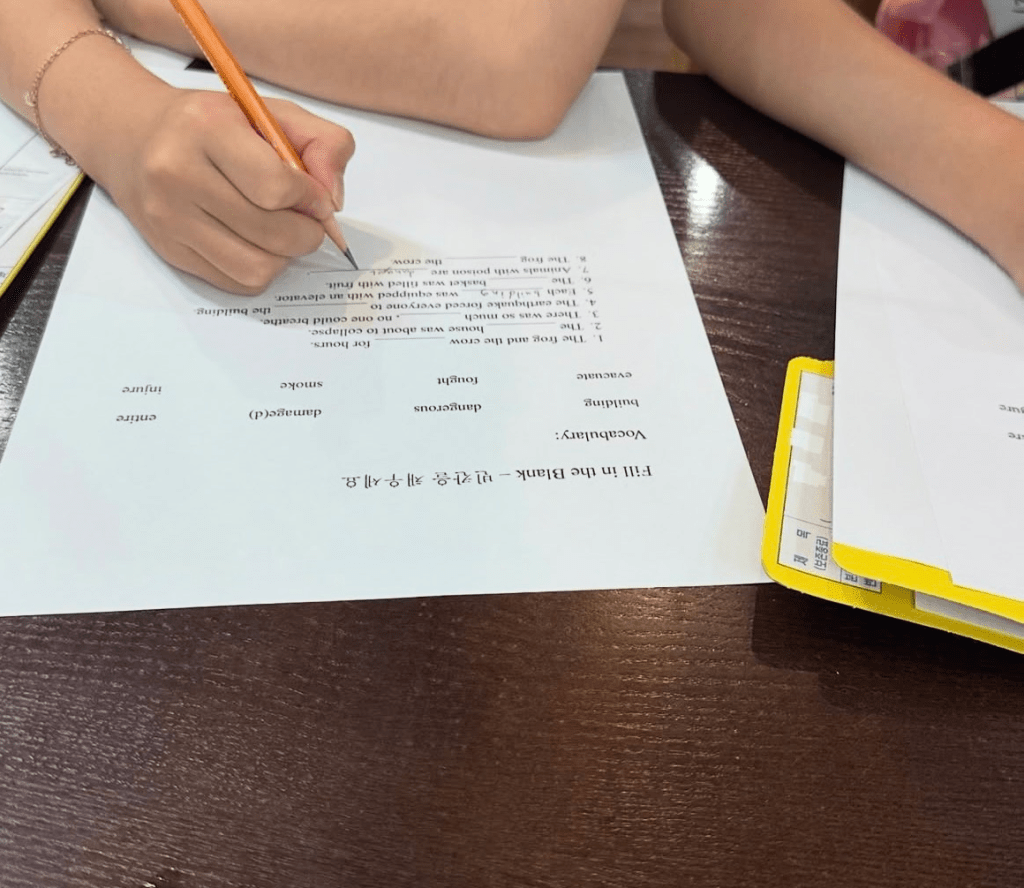
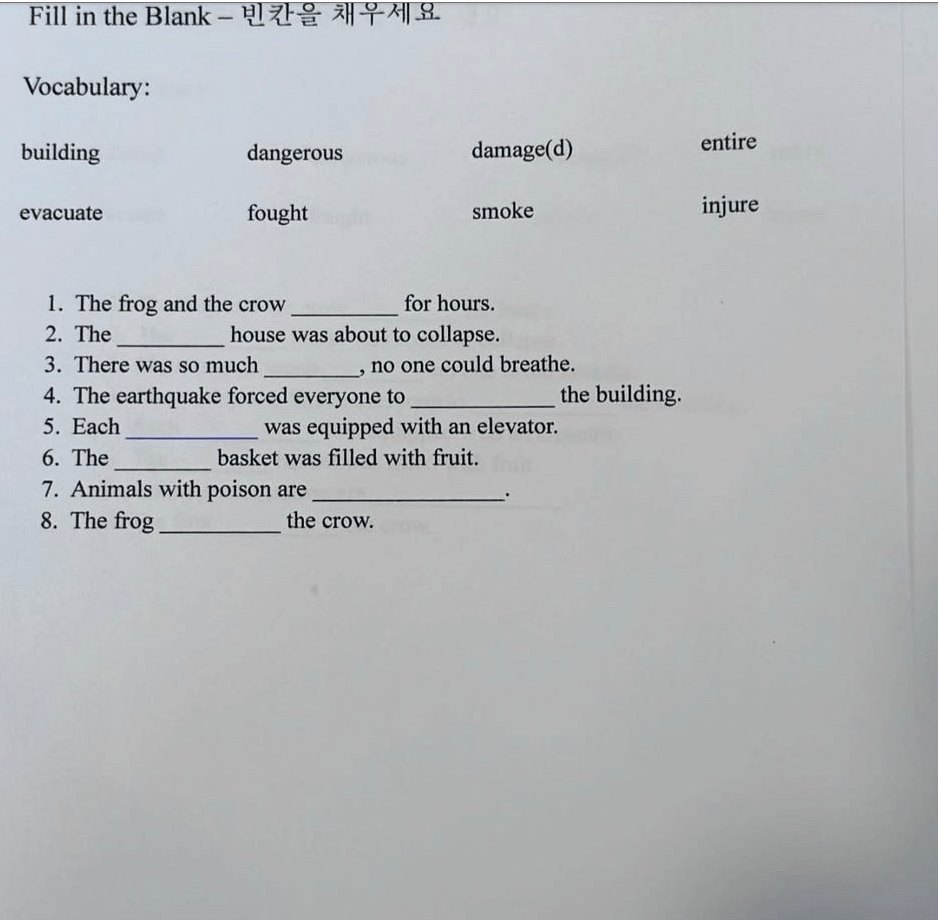
This is a picture of one of the worksheets our volunteers bring!
Ms. Lim’s interview shows how education can connect people from different cultures and experiences. At Daoom, learning English is not about getting every answer right but about gaining confidence and communicating with others. She reminds us that as Korea becomes more globalized, students need more opportunities to practice English in open and encouraging environments. Unlike the strict, exam-focused atmosphere in many schools, Daoom helps children discover that English can be part of daily life and friendships. Through Ms. Lim’s guidance, students learn that language is not just a subject but a tool to connect and grow together. Daoom represents how learning and community can come together through care and understanding.
Alice Kim is a senior at Gwacheon Foreign Language High School in Korea, and before that, she attended Branksome Hall Asia in Jeju for 3 years.
Can you introduce yourself?
Alice: Hello, my name is Alice Kim, and I’m a senior at Gwacheon Foreign Language High School. Before that, I attended Branksome Hall Asia, which is one of the international schools in Jeju with an IB curriculum.
As you have experience in an international school and a Foreign Language High school in Korea, would you please share some differences in school life?
Alice: First of all, attending an international school provided a wealth of activities and diverse experiences. There were numerous after-school activities, and sports-related experiences and physical education were important subjects, so it felt like being good at sports was crucial. There was also a lot of communication with teachers and group activities, so there were a lot of things to do together. There were also a lot of field trips, a bit like university. On the other hand, foreign language high schools rarely had field trips and seemed to have less interaction with teachers. Furthermore, since most students worked on their own projects, there were no group activities and the variety of activities was somewhat limited.
What differences have you personally felt in your studies between these two schools?
Alice: International schools definitely felt like they demanded a wide range of skills. Rather than memorizing, I felt like I needed to start from within and showcase who I am. This increased self-reflection helped me identify areas where I needed to improve. Furthermore, assessments weren’t limited to a set period of time; they were conducted consistently throughout the year. Furthermore, there were numerous presentations where students had to share their thoughts. In contrast, foreign language high schools seemed to prioritize doing well on exams. Rather than focusing on individual strengths or interests, the study schedule was clearly defined, based on textbooks and workbooks. Because the assessment was based on a single exam, there seemed to be little time for self-reflection. Furthermore, memorization and mastery of the school’s prescribed subjects seemed to be paramount.
How would you compare and contrast the two types of schools based on the experiences above?
Alice: I think international schools offer more to do. While I’m expected to think independently, foreign language high schools don’t require me to express my own thoughts beyond diligently solving workbooks and reading textbooks. Coming to foreign language high schools was a bit challenging because, unlike international schools, my own opinions weren’t allowed to enter the equation. If I diligently read and practiced a lot, my grades improved. However, there were some things at international schools that I couldn’t achieve no matter how hard I tried, so I often wondered if I could do it. However, there were far more opportunities to interact with people than at foreign language high schools, which really helped my conversational skills. However, foreign language high schools focused more on theory than memorizing grammar and content from books.
Alice’s journey across two very different educational systems highlights the ways in which school environments can shape not only academic habits, but also personal growth and perspectives. At Branksome Hall Asia, the international school’s emphasis on self-reflection, presentations, and diverse activities encouraged her to develop independence and confidence in expressing her ideas. In contrast, Gwacheon Foreign Language High School demanded discipline, focus, and mastery of structured academic content, leaving little room for individual voice but sharpening her ability to work rigorously toward clear goals. Together, these experiences have given Alice a unique vantage point: she understands both the freedom and challenges of inquiry-based learning and the precision and intensity of exam-centered study. Her reflections remind us that education is not one-size-fits-all, and by navigating both systems, she has gained resilience and adaptability that will serve her well beyond the classroom.
In today’s 21st-century global society, an increasing number of young students are growing up with diverse cultural experiences from an early age. Sua Park is one such student. Born and raised in Korea, she has followed an international education pathway since kindergarten, allowing her to develop a global mindset while staying rooted in her home country.
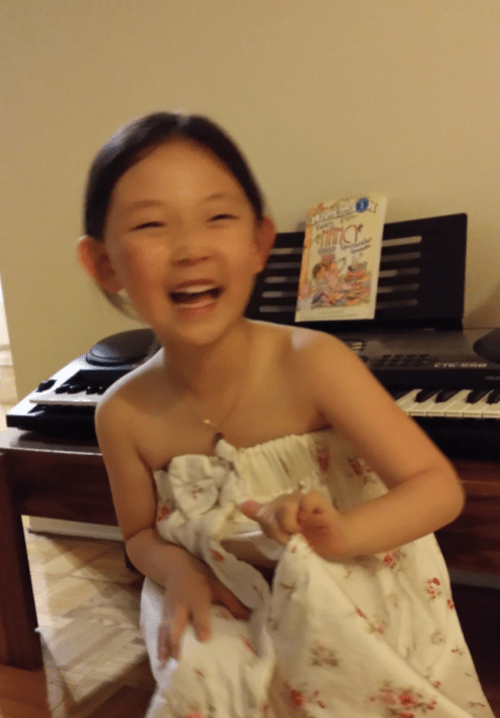
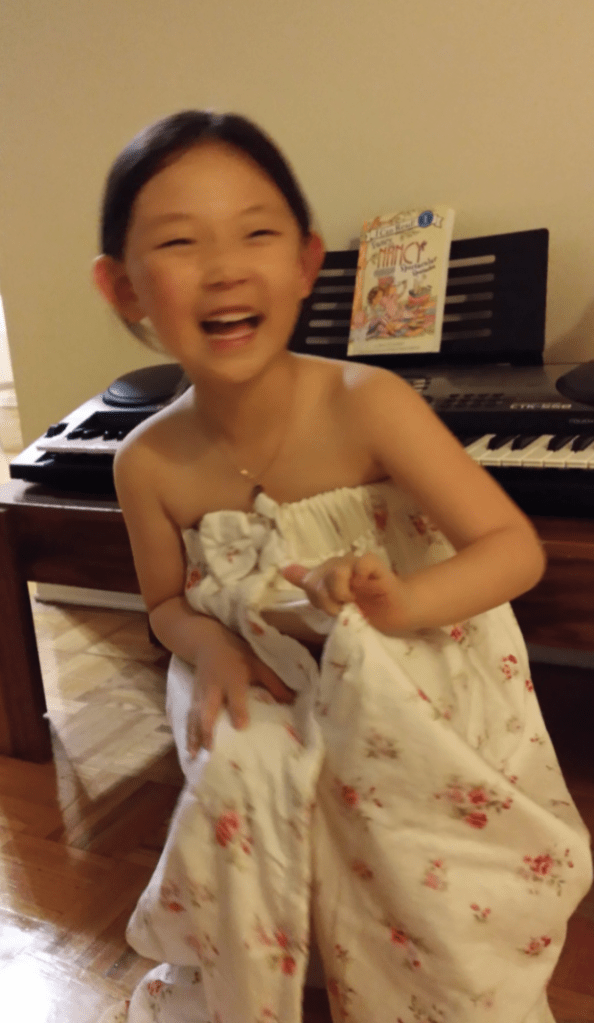
This is a photo of Sua, when she lived in Canada.
Could you please introduce yourself? What are your future plans after graduation?
Sua: My name is Sua Pak, and I’m currently a senior at Branksome Hall Asia. After graduation, I plan to move to the United States and major in graphic design. My goal is to gain experience in the industry, hopefully working in a company to build my career. I’m particularly interested in branding and may specialize in that area. Eventually, I hope to start my own business in the creative field.
Although you were raised in Korea, you attended international schools from kindergarten onward and followed a global curriculum. What are some advantages and challenges of having been educated in an international system, particularly the IB?
Sua: Since I’ve never experienced the Korean national curriculum directly, I can’t fully compare the two. But from what I know, international curricula like IB give students more space to explore topics independently and take initiative in learning. In contrast, the Korean system seems more rigid and structured—almost like working in a machine. I think that difference also reflects deeper cultural values, like tradition and emotional restraint. Because I’ve been learning in this independent way for a long time, I’ve developed stronger problem-solving skills than many of my peers, and I’ve been able to improve my English naturally without needing separate language study. That said, being in Korea while following an international curriculum can be tricky. Many Korean students still go to after-school academies (hakwons), which is a big part of student life here. Since I don’t attend hakwons, I’ve had to work two to three times harder on my own to keep up—which can be physically and mentally exhausting.
You lived in Canada for a short time—did you ever experience any culture shock or moments that stood out to you while you were there?
Sua: Outside of school, I didn’t feel much culture shock because I was usually with adults. But in school, I did face racism. Even though I was in the same class as an older Korean friend and I studied hard, both white and Black students made fun of me. One time, I brought a packed lunch with Yubu Sushi (Cone Sushi), and they teased me about the vinegar smell. And I could easily figure out that their stereotypical thoughts were exactly from the famous TV show that they watched at that time, which was very ridiculous. But honestly, I have a pretty tough mindset. I told myself, “I’m better than them,” and just moved on. That kind of mental control really helped me not to let it affect me too much.
Sua’s story highlights the quiet strength it takes to grow up between systems, cultures, and expectations. From learning to rely on herself without the extra support many of her peers receive, to facing moments of cultural bias abroad, she has developed a resilient mindset grounded in self-belief. Her journey shows that global education is not just about speaking English or attending international schools, it’s about learning to adapt, to think independently, and to find confidence in who you are. As she looks ahead to a future in design and entrepreneurship, Sua reminds us that individuality shaped by cross-cultural experience is not only powerful, it’s essential in an increasingly connected world.
Jiwoo Choi is my sister and a rising freshman who has recently been accepted into Saint Paul Preparatory School in the Seocho district. She has attended more than four different international schools in Seoul, all of which have either an English or American curriculum, despite never having lived abroad. Her perspective differs significantly from that of the majority of international students, as her only source of connection to her home language or culture comes from within her family, while she is neither a second-generation immigrant nor does she have permanent residency in any foreign country. Jiwoo provides insight into the challenges of having a strict social and cultural division, and is concerned with how she doesn’t have a single standard of living. This is amplified since her career, following her studies abroad, will most likely require her to reside overseas, and she is unsure about selecting a country when she has only ever experienced a mixed environment.
Sieun: Please introduce your personal and academic background.
Jiwoo: I’m Sieun’s little sister, Jiwoo. Unlike Sieun, I’ve never attended Korean public school, and every one of my friends and acquaintances is an international school affiliate. I’ve studied according to American textbooks most of my life, and speak Korean only at home. I have moved frequently within Seoul, changing schools, and I’ve also traveled abroad a lot.
Sieun: How would you describe your school and social life compared to your life at home?
Jiwoo: I think the simplest yet greatest difference is language. A social studies teacher once showed our class a TED talk about how language shapes cognition, not only in terms of grammar, range of expressions, and meanings, but also in the way people carry themselves. That was the most relatable thing I’ve ever heard. In school, where I speak English and also mostly follow North American social cues because there are foreign teachers and students, I act more sociable in some sense, but on the other hand, try to stay out of others’ and my boundaries more, like being extremely talkative and bubbly but at the same time only touching on surface-level conversational subjects.
At home, not only with my direct family, but also during holidays when we travel to our grandparents’ house to meet relatives and random visitors, I sometimes feel a sense of discomfort around people, especially the elders, who ask more about my business. But I also think that I’m being cared for more.
Sieun: Were there any difficulties from this divide?
Jiwoo: I’m a student, so most of the time I’m occupied with homework, studies, clubs, and other school-related activities, even at home. Honestly, apart from that, I speak Korean at home, and just in the streets, and I notice little cultural differences in, like, the way people greet each other, I don’t really experience a totally “Korean” lifestyle. But if you think about it, I also can’t say that I identify with the American nationality. I’ve also been in English schools, and the range of an international school that I experienced is huge. So, the conversations I have and the media I consume just have a vaguely North American hint in a spatially Korean context. I know that not all International students are this unsure or even see this as a problem. Still, I sometimes feel anxious that I don’t have the strongest national pride or connection to Korea, apart from its geographical location, and neither to America, apart from what I have been exposed to through the international school system. It can feel like I’m not entitled to either, and sometimes like I don’t belong anywhere.
Sieun: In the future, how do you think you can manage this discomfort, and decide where to either spatially or emotionally settle?
Jiwoo: All the education I’ve ever had is in English, so I’m set on going abroad for my bachelor’s degree. I’m actually kind of excited, because at least then, I’ll have a few years to experience one nation fully. I’ll decide where to reside for the rest of my life after experimenting. I also always felt like I would need at least a short-term work experience in South Korea, because my family is here, and I’ll honestly just have to give everything a try. I would have to consider realistic factors, such as whether I can secure a visa elsewhere and if I’m ready to leave one of the safest countries, both literally and emotionally, for me. Because there is comfort in homogeneity, and I’m unsure whether studying abroad will make me miss it or disregard it.
Jiwoo’s interview reveals the effects of the lack of a single national identity or pride on a developing teenager. She shares the common experience of an international student or a second-generation immigrant, which is having to switch languages completely from their school and social life to their familial interactions. Apart from the way this language barrier sometimes creates cultural barriers, since language dictates thinking, as she mentioned, her anxiousness toward her national identity comes from having a school-centered life, almost without any Korean social influence, except that from her parents. Her willingness to take risks by experimenting with life in different countries to discover what shapes her mind and identity to their fullest potential is admirable. This kind of openness towards selecting one’s own culture or cultures, and ultimately their lifestyle, is increasingly needed as we move forward in globalization.
In today’s increasingly interconnected world, many students are growing up with influences from multiple cultures and educational systems. Sungeun Kim is one such student. Now a senior at Branksome Hall Asia, Sungeun is known for her strong sense of purpose and global outlook. With a clear goal of becoming a doctor, she is preparing to study medicine in the UK. Her journey reflects how a multicultural upbringing and international education can foster adaptability, empathy, and a sense of belonging across borders.
Could you please introduce yourself? What are your future plans after graduation?
Sungeun: My name is Sungeun Kim, and I am a senior at Branksome Hall Asia. I have dreamt of being a doctor passionately since Grade 8, so after graduation, I can picture myself finishing 6 years of studying at a medical school and then working at hospitals as a doctor, hopefully in the ER or the Trauma Center.
This is a photo of Sungeun and her sister, when they lived in Canada.
You grew up with a multicultural background—your mother is of mixed heritage, and your sister is currently studying in the UK. Have you had any memorable or culturally eye-opening experiences while navigating different cultures?
Sungeun: My life was full of new cultures. Apart from my mom and sister, my aunt and uncle are Canadians, and my cousins are Chinese. Therefore, whenever our family would plan family trips, they were all memorable and culturally eye-opening. I encountered not only Asian culture, but also other ones while talking with them or even while eating food. One thing that I learnt as a person who grew up with a multicultural background was that every culture is amazing and beautiful, and there is no such culture that should be treated unequally.
This is funny, but also one of my absolute most memorable experiences. Most of my family is from Korea, Japan, and China, which are all Asian countries. However, only my aunt and uncle are from Canada, and they have a very different lifestyle compared to us. My aunt was still raised in Korea, but my uncle is half Canadian and half Hong Kongese. When I first met him, I was worried that he might feel pressured in getting used to our culture and how our family lives, and when he first arrived, he looked confused, especially when sharing food. Over time, he was used to Asian culture and he was just like one of us. From this experience, I learned that adapting to one’s culture depends on your mindset, and there is no such excuse that could stop one from assimilating into a new culture.
This is a photo of the building in the UK, taken by Sungeun.
We heard you recently visited your sister in the UK. Were there any noticeable cultural differences between Korea and the UK that stood out to you during your time there?
Sungeun: My sister is currently studying at Edinburgh, UK, and since I am planning to apply to UK universities, our family thought it would be nice to visit the UK before applying. There were two noticeable cultural differences while I was there for almost a month. I have always heard that people living outside of Asia, and especially Korea, don’t tend to care about others, in a good way, such as minding one’s body shape, skin tone, or even their personality. Differently, in Korea, it is all about being pretty and skinny, which decides if someone is attractive or not. I thought that the UK culture, and probably a lot of others too, prioritized myself more than others. Also, this is kind of a bad experience that I encountered, but maybe because people prioritize themselves, they weren’t really thinking about basic etiquette. A lot of people blew cigarette smoke in front of my face, even though they knew that I was going to walk in front of them. This is not imaginable in Korea, where cigarettes are treated kind of negatively and where drugs are illegal.
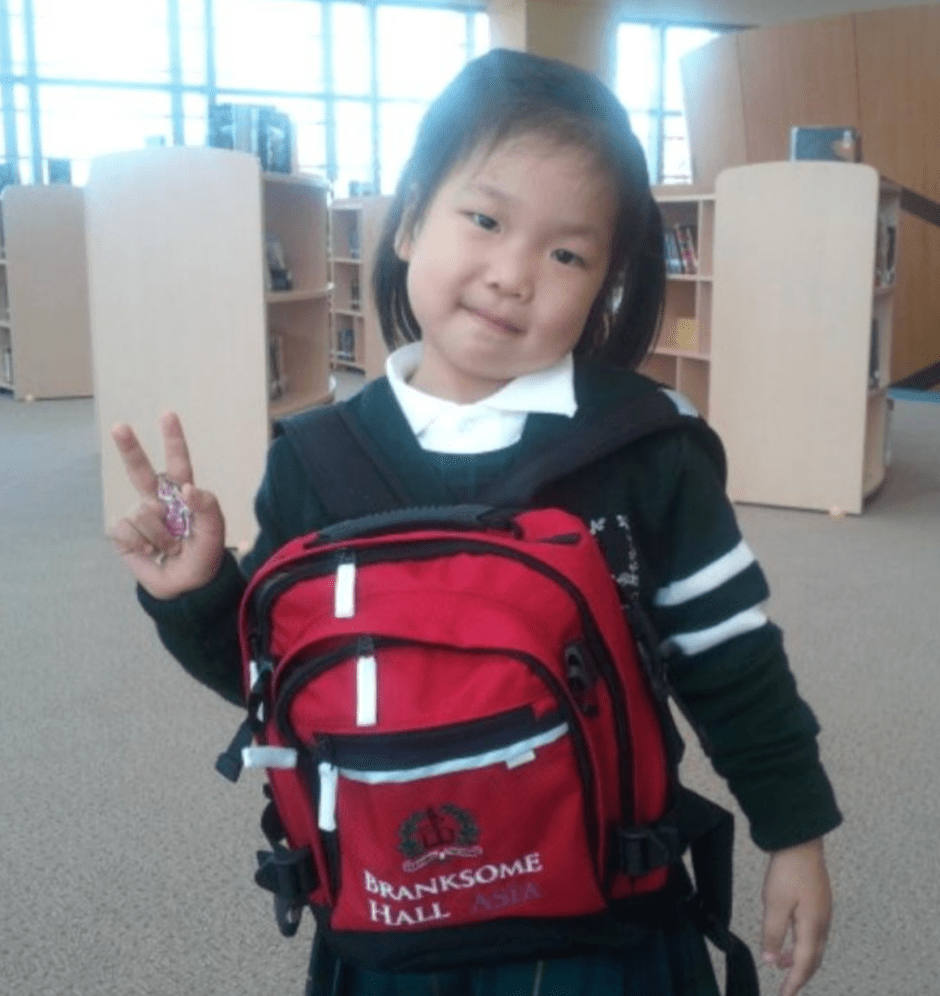
This is a photo of young Sungeun in Branksome Hall Asia Library
Although you were raised in Korea, you attended international schools from kindergarten onward and followed a global curriculum. What are some advantages and challenges of having been educated in an international system, particularly the IB?
Sungeun: As I graduate this year, I am completing fourteen years of being a student at an international school. The biggest takeaway from following a global curriculum, in general and not specific to the IB, is that there is no boundary between me and any other foreign country. I have encountered many foreigners in my life, including teachers and friends, and my very first friend was from Belgium. The open mindset helped me to adapt quickly to unacquainted situations, such as never feeling left out even though there aren’t any Koreans. Another advantage would be that English feels like my second mother tongue. Unlike people who learn their second language after being fluent in their mother tongue, I learnt English along with Korean, and basically I have developed them to the same level. English is now one of the most comfortable languages I have a good command of, and considering the fact that I will be working abroad in the future, this would be the biggest advantage I have gained from being educated in an international system.
Particularly for the IB program, it focuses on the independence of individuals through critical thinking and a holistic approach to education. Not only critical thinking skills, but IB has shaped me as an individual who can seek help when needed, but also know how to find solutions on my ability. There were, of course, challenges in between these learning situations, such as dealing with stress; however, all of the challenges were one learning opportunity that could not be wasted.
Sungeun’s reflections reveal the depth and complexity of growing up between cultures, not just in daily habits, but in values, perspectives, and relationships. Whether learning resilience through cultural adaptation, or embracing the independence and inquiry-driven mindset of an international curriculum, she has developed the tools to navigate a global society with confidence and purpose. Her story reminds us that cultural openness is not only about travel or language, it’s about being willing to learn from differences, to connect across unfamiliar lines, and to carry those lessons into the future. As Sungeun steps into the next chapter of her journey toward becoming a doctor, she embodies the mindset of a new generation ready to heal and lead in a borderless world.
Ava Hill is a rising junior at Chadwick International. Her perspective highlights not only the spatial differences that stem from the distance between the US and South Korea, but also those within a multicultural family. Ava travels frequently to her home state, Idaho, which enables her to stay in touch with her American cultural heritage. Her experiences with a North American school curriculum, similar to that of the US, in a spatially Korean background provide meaningful takeaways regarding cohesion.
Sieun: Please introduce yourself and your national background..
Ava: Hi! My name is Ava Hill; I attend Chadwick International, and I am half Korean and half American. My mom is Korean, and my Dad is American! I lived in Idaho all of elementary school, then moved to Songdo in middle school. I am now 16 years old.
Sieun: What are some cultural differences you felt between your state and Songdo?
Ava: In Idaho, it was a very small town and open spaces to play with friends, compared to Songd,o which is more of a city and busier and faster paced. While living in Idaho, we lived in a standard 3-story suburban house with a backyard, a garden, and a baseball hoop. In Songdo, I live in a very small, cute apartment with lots of stuff around my apartment! We can walk to so many stores for anything you need, unlike in Idaho, where you usually need to drive!!
Sieun: How does doing the IB curriculum and following mostly North American academic and cultural standards at school, while spatially residing in South Korea, affect your identity?
Ava: Doing IB in Korea has made my school experience very different from the North American high school experience. At CI my school follows some of the North America cultural influences, the academics standards are much much more intense and focused on the grades, compared to my friends school in Idaho where they want to emphasize more on enjoying high school life, sports, dating, etc. living in korea but learning in an international IB environment has made me into someone who works hard and pushes for academic success. Still, it also makes me aware of trying to balance achievement with enjoying school life.
Sieun: Is there anything different in your ‘day in the life’ abroad (including traveling) and in Songdo?
Ava: In Songdo I can walk to school in around 10 minutes, compared to Idaho, where you drive around 20 minutes to get to school!! I am able to travel around countries in Asia and for much cheaper!
Ava’s interview highlights the many differences that are noticeable in daily life between Songdo and Idaho. She explains how the difference in the size of land, and the following changes in transportation or form of housing are one of the greatest adaptations her family made while moving to Korea. Ava also notes that she experienced more academic pressure and a focus on grades, which was a common trend noticeable from almost every interview including a change to, not always a Korean school system, but a spatially Korean setting.
Suhyeon is a 2nd grader in a Korean public high school. She attended international schools early in her life to learn English and potentially consider studying abroad, but now focuses on the Korean college admissions process. Suhyeon transferred first to a Korean elementary school in 5th grade, and has ever since lived in an extremely academically driven region, Banpo. Her perspective reveals how the most dominant cultural influence early in life lasts long into teenage years, even after being detached from it, and the difficulties in adjusting to the more strictly academic environment.
(This interview has been translated)
Sieun: Please introduce yourself.
Suhyeon: Hello, I’m Suhyeon. I’m in Grade 2 at Banpo High School. I don’t have to say much outside of that since I’m a ‘go-sam’, or senior in high school, just next year, and these days I study all day to prepare for that. I always had a focus on that, but the pressure has been added especially since we ’08s, or our age class, are the last class before the government changes the curriculum, so we can’t really afford to retake the KSATs.
Sieun: How has the transition been from an international school to a Korean public school? Do you still feel the influence?
Suhyeon: I kind of still do, yes, in that I had to work harder at the start to catch up on my studies. I feel that Korean schools are much more academically rigorous, and there’s a lot more pressure to study ahead of what the class is currently teaching. But obviously, we have different priorities, like the kids that go to international school, whom I still keep in touch with, are driven in a different sense. They don’t sit at a desk for twelve hours, but they are more extracurricular-based and are required to do something crazily innovative to awe the admissions officers. I don’t know what’s worse for our mental health. Maybe I’m nostalgic because it’s a stressful season for me right now, but I did have the chance to experience something different and somewhat unique in Korea, so I sometimes miss the sports I used to play and that atmosphere in general. Especially recently.
Sieun: What was the most significant cultural difference between those school environments?
Suhyeon: Culturally, like between friends, I think the biggest difference was the way we get to know each other. Although I was only there for elementary school, we still had a wide range of extracurricular activities, including forensics, robotics, the book club, sports, and more. I bonded with my friends back then through early shared interests. In Korean schools, because we stay in our homerooms all day and don’t move rooms between classes, we just get to know whoever’s in our advisory group. Honestly, in high school, we don’t put much time into those relationships at all since our grades are the priority. During exam seasons, we literally study during all breaks, and some even skip lunch.
Sieun: How do you think this transition has shaped your identity?
Suhyeon: The concept of identity too, Korean students don’t really pursue their respective passions outside of our studies if you’re not entirely set on that career, as in, labeled as ‘yaechaeneng’, which has a whole another competitive admissions process. I don’t know, I think I’d have to be secure in a university before having the chance to explore my identity. I don’t know if it’s because I’ve experienced an international school, but I’m hoping to work abroad someday after graduation, though, in the short term. I want to experience as many diverse cultures as possible.
Suhyeon’s interview highlights the differences in academic pressure between international, North American, and Korean schools. In either environment, most students struggle to meet the standards of college admissions officers and entrance exams. Although stressful, she understands that this experience of diligence is a necessary part of teenagers setting baseline expectations before freely experimenting with their identities as adults.
Minji Lee is a 17-year-old student who recently moved from Korea to England. She has been attending a boarding school in Bath, a small city in southwest England, for the past year. Minji shares her unique experience studying in a mostly Asian international school with very few Koreans, living alone in a quieter city unlike the bustling environment of Korea. Her perspective reveals the challenges of adjusting to a new cultural and educational system, as well as the differences between life in Korea and England. Unlike the common expectation that boarding school life in England is like something out of Bridgerton or Harry Potter, Minji’s experience shows a very different reality. Minji’s story highlights the real challenges international students face as they balance identity, culture, and education far from home.
Can you introduce yourself and tell me where you currently live? What do you do?
Minji: I’m Minji Lee and I’m a friend of Janice. I went to a Korean public school in Seoul for most of my life and moved to England last year. Since then, I have been attending a boarding school in Bath. I can share what it’s like to study in an environment with very few Koreans and to live alone in a quieter city like Bath. Most of the students at my school are from China and Hong Kong, and there are no local English students.
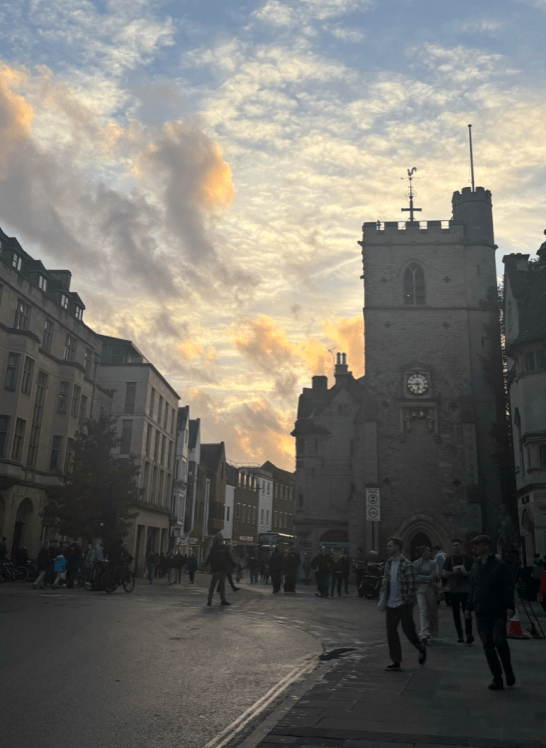
This is a spot in front of my school in Bath. In the afternoons it feels calm and peaceful, and the sky looks beautiful.
How would you describe your daily life compared to your home country?
Minji: Honestly, people have certain expectations when they hear that I live in England. I also thought I would be living and studying with English students, but since I attend an international school, most of my classmates are from China, Hong Kong, and Taiwan. Almost everyone speaks Chinese, which makes it hard for me to communicate and sometimes creates cultural clashes. I often feel left out or uncomfortable.
Back in Korea, things feel very different. It’s my home country, and I lived there before moving to England, so I feel much safer and more comfortable using my language freely. But there are certain places here that remind me of Korea too, like this chicken place in front of my school in Bath. When I’m there, I feel like I’m back in my hometown!
What are some cultural differences you have noticed between Korea and England? In your school?
Minji: One of the biggest differences is how people interact and socialize. In Korea, students tend to stick with their close friend groups, and there’s a clear sense of hierarchy based on age. At my school in England, even though most students are also Asian, the atmosphere feels more individualistic. People are polite but not as group-oriented, and English people value personal time more. Also, I noticed that students are generally more private and reserved. It’s harder to become close right away.
How has your experience with education differed in Korea versus England?
Minji: In Korea, the focus was more on memorization and test scores. We had long school hours and extra classes after school. It felt very structured and intense. In England, the approach is more discussion-based. We spend a lot of time analyzing and debating ideas in class, which is new for me, especially in my psychology class. Also like there was no psychology class back in korean public school, so there’s more emphasis on critical thinking and expressing your opinion. I’ve learned a lot, but it was definitely hard at first to adjust.
Minji’s interview reveals the multifaceted experience of living and studying abroad as a Korean student. She shares how expectations can differ from reality, especially when surrounded by classmates from other Asian countries rather than local English students. Her reflections on daily life highlight the challenges of dual cultural adjustment: adapting not only to life in England but also managing cultural differences within a predominantly Chinese-speaking school community. Educational differences further shape her experience, with England emphasizing critical thinking and discussion compared to Korea’s structured memorization approach. Minji’s story reminds us that adapting to a new culture involves managing both social and academic changes. Her journey shows the resilience of a teenager facing difficult adjustments and an openness to learning in unfamiliar environments.
![책꽂이] 학벌주의가 낳은 '기이한 아수라장' 대치동의 민낯 | 서울경제](https://newsimg.sedaily.com/2021/11/25/22U5L7XIA0_7.jpg)







 Humans of Korea